

For SLA and SLS we use machines and materials from Formlabs; for FDM we use Prusa printers and filaments sourced exclusively in Europe. This page explains why that matters for your part – and lists exactly what stands in the workshop.
Why machine and material belong together
A 3D printer is only half of the result. The other half is the material – and above all the profile the machine uses to process it: exposure times, temperatures, layer parameters. When machine and material come from the same manufacturer, those profiles are not an approximation but were determined for exactly this combination. With resin that makes the biggest difference, because material data and exposure are directly linked: a resin that does not match the machine cures unevenly, and you can see that on the part.
That is why we stick to one manufacturer for SLA and SLS – Formlabs – and source machine, resin and powder there. For FDM, where the link is looser, we rely on Prusa printers and on filaments from European manufacturers whose data sheets we know and whose batches we can trace.
SLA: Formlabs Form 4
The Form 4 cures liquid resin with a light source, layer by layer at 0.05 millimetres. That gives smooth surfaces and fine detail – housings, figures, casting patterns, fitted parts. All resins come from Formlabs and are matched to the Form 4.
| Resin | What it is made for |
|---|---|
| Standard – grey, black, white, clear | Finest detail and very smooth surfaces. Display models, figures, prototypes; Clear is translucent. |
| Tough 1500 | Tough and resilient, springs back. Snap fits, flexures, brackets under sustained load. |
| Tough 2000 | Impact-resistant and robust. Functional prototypes, load-bearing housings, jigs and fixtures. |
| Rigid 10K | Glass-filled, around 10,000 MPa tensile modulus – the stiffest resin in the range. Fixtures, thin ribs and webs, mould inserts, loaded parts that must not deform. |
| Castable Wax | Burns out without residue. Casting patterns for jewellery and investment casting. |
| Elastic 50A (on request only) | Rubber-like, stretchable. Seals, grips, dampers, anatomical models. |
One limit applies to all resins: they are not UV-resistant. For parts that live outdoors we offer UV protection as a finishing option – or the part goes to FDM in ASA.
SLS: Formlabs Fuse 1 and Fuse Sift
The Fuse 1 fuses nylon powder with a laser, layer by layer at 0.11 millimetres. Because the surrounding powder supports the part during printing, no support structures are needed – undercuts, internal cavities and moving assemblies come out of the machine in one piece. Parts are unpacked in the Fuse Sift, which recovers the unfused powder.
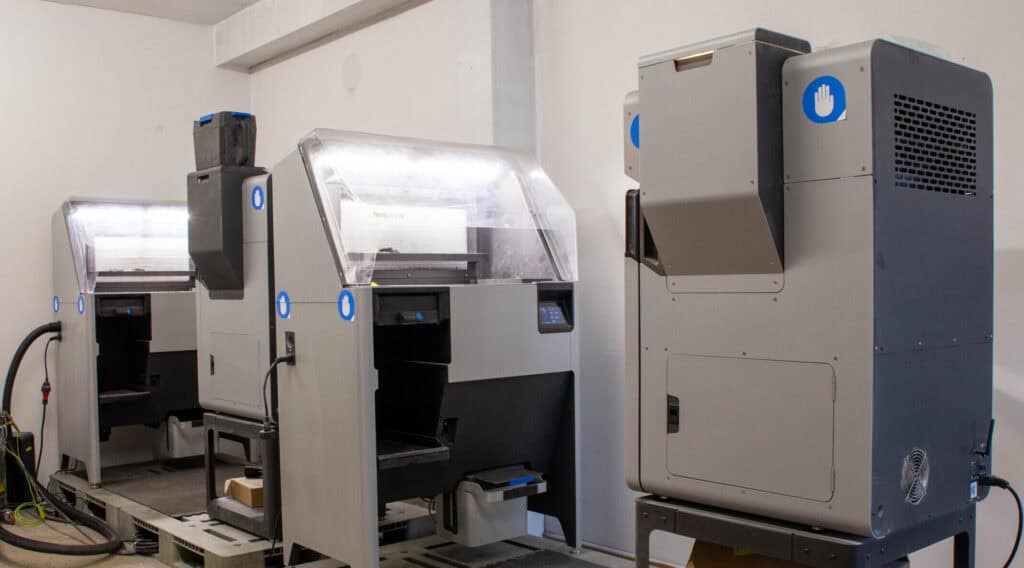
Nylon PA12 is strong, tough and dimensionally stable, resistant to oils, greases and many chemicals, and almost isotropic – equally strong in every direction. That makes it the material for functional parts, spare parts and fixtures. TPU 90A is rubber-elastic and used for seals, buffers and flexible components. Both powders come from Formlabs.
FDM: Prusa printers, filaments from Europe
In FDM, molten plastic is laid down layer by layer at 0.15 to 0.20 millimetres. It is the least expensive of the three processes and the one with the widest choice of materials and colours. We print on machines from Prusa – a European manufacturer whose printers are openly documented and, in part, user-serviceable. For us that is not a side issue: a machine you can maintain yourself does not stand idle for weeks.
| Family | Colours | What it is made for |
|---|---|---|
| PLA | 11 | Bio-based, stiff, dimensionally accurate, the least expensive material. Low heat resistance – for display models, decoration, housings without heat load. |
| PLA Plus | 6 | Tougher than PLA, less brittle. For parts that need to take some punishment but do not get warm. |
| PETG | 17 | Tough, slightly flexible, chemical-resistant, good for fitted parts. The widest colour range. |
| ASA | 8 | UV- and weather-resistant, more heat-resistant than PLA. For anything that stays outdoors. |
| ABS | 4 | Impact-resistant, heat-resistant, resistant to oils and greases. |
| Green-TEC Pro | 5 | Bio-based and yet more heat-resistant than PLA. For technical parts with a sustainability requirement. |
| ESD-PLA | 1 | Electrostatically dissipative (10⁶–10⁸ ohm). For fixtures and housings in electronics manufacturing. |
| PCTG | 1 | Considerably more impact-resistant than PETG, highly transparent. For loaded visible parts. |
| PETG V0 | 1 | Flame-retardant to UL94 V-0, halogen- and PFAS-free. For safety-critical applications. |
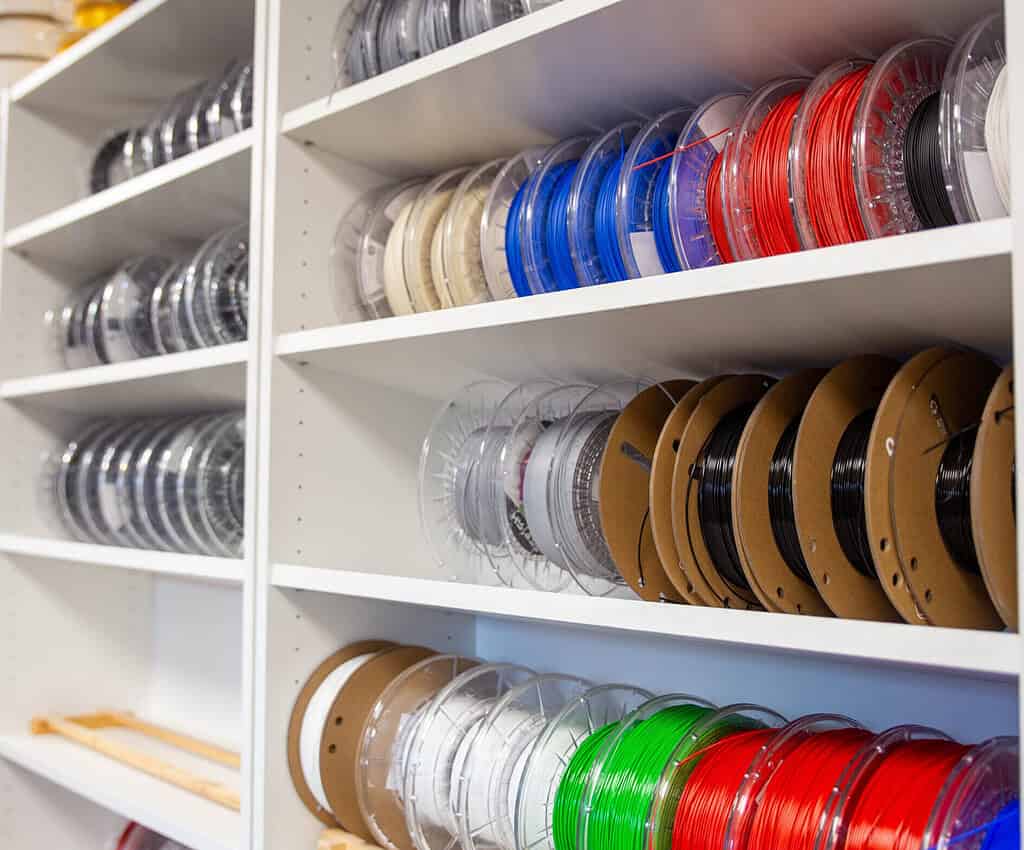
All filaments are sourced exclusively from European manufacturers. There is a practical reason: we know the data sheets, we get an answer when we have a question, and quality does not vary from batch to batch.
Many printers, one workshop
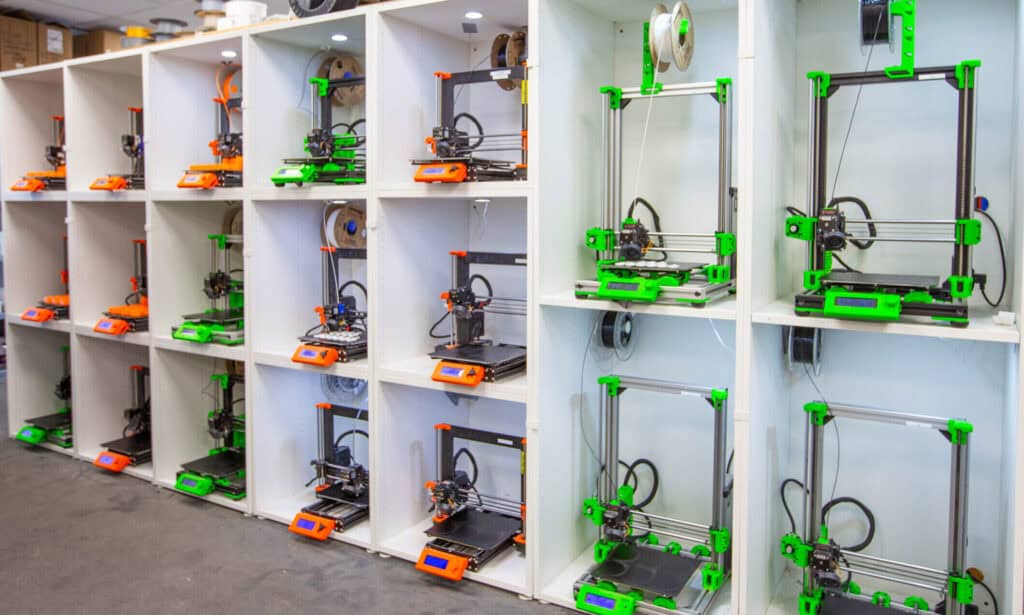
The FDM printers stand side by side in a shelving wall, and many of them run at the same time. A larger order therefore does not block the single parts next to it – and larger quantities still ship promptly. Everything is made in our own workshop in Verden (Aller); we produce ourselves and buy nothing in.
Who is behind the workshop, and since when, is on the About us page. Which process suits which part is shown in the process comparison.
Upload a file, choose a material
After upload, the price calculator shows the prices for all three processes side by side and recommends a process and material – the decision stays with you.